
External Demand Reveals Operational Friction
Customer search behavior shows where self-service fails – before it hits your operations.
Customers don’t only struggle inside your systems.
When self-service fails, they leave – and search elsewhere.
These signals reveal where operational pressure is already building.
Why External Demand Matters
Internal analytics show what happens inside your systems.
They do not show where customers fail before they reach them.
Internal analytics are well suited to explain what happens on owned platforms. They show drop-offs, error rates, and process performance. What they typically do not explain is why customers leave those channels and actively search elsewhere for help.
External search behavior fills this gap. When customers repeatedly search for answers to the same operational questions, it indicates unresolved friction that self-service journeys fail to absorb. These signals exist outside booking funnels, apps, and service portals, but they reflect real and recurring demand.
Without this external perspective, prioritization decisions are often driven by internal visibility, stakeholder pressure, or anecdotal evidence. This makes it difficult to assess where operational effort will have the highest leverage and where customer frustration is already accumulating before it surfaces internally.
What VeltraCX Is and Is Not
VeltraCX is designed as a decision-support intelligence product. Its purpose is to make systemic customer friction visible and to provide a structured basis for prioritization at CX, digital, and operations level. It does not aim to replace existing analytics, operational reporting, or internal decision-making processes.
VeltraCX creates a structured view of where operational pressure is building and where support demand is likely to concentrate.
By translating external search behavior into structured friction clusters, the analysis highlights where operational pressure is already building and where support demand is likely to concentrate. This provides a clear basis for prioritization across CX, digital, and operational teams.
The output is an analytical artifact designed to support decision-making. It identifies areas of concentrated friction and indicative cost exposure, enabling organizations to focus on the issues with the highest operational relevance.
VeltraCX does not replace internal analytics or track performance. It does not measure implementation success or define execution.
All financial figures are directional, based on real customer demand signals and the organization’s own support cost structure, and intended to support relative prioritization and risk assessment.
Interpretation, prioritization, and execution remain with the organization.
What VeltraCX Provides
VeltraCX provides a recurring Friction Intelligence Report that summarizes where external customer demand concentrates around unresolved operational and self-service issues. The report is designed to be read by CX, digital, and operations leaders and to support prioritization discussions rather than operational execution.
Each report identifies the most relevant friction clusters based on external search behavior and groups them into a structured taxonomy. This makes it possible to distinguish isolated issues from systemic patterns that repeatedly drive customers to seek help outside owned channels.
For each friction cluster, VeltraCX provides an indicative view on cost exposure derived from observable demand signals and conservative assumptions. These figures are not forecasts or savings claims. They serve as a relative signal to help assess where operational pressure and support demand are likely to be most concentrated.
In addition, the report includes ownership hypotheses and design-level intervention patterns. These are intended to support internal alignment and framing, not to prescribe solutions or implementation plans. All decisions regarding scope, feasibility, and execution remain with the organization.
This analysis is delivered as a recurring Friction Intelligence Report used in executive prioritization.
What the Friction Intelligence Report Covers
The Friction Intelligence Report provides a structured view of recurring customer friction as it appears in external search behavior over a defined period. It is designed to support executive review and prioritization rather than operational follow-up or implementation tracking.
Each report starts with a management-level summary that highlights the most relevant friction areas observed in the period and explains why they matter from an operational and customer experience perspective. This summary is intended to be readable without prior context and to support steering discussions.
The core of the report consists of ranked friction clusters derived from external demand patterns. These clusters group related customer issues into a consistent taxonomy, allowing organizations to distinguish isolated questions from systemic friction that repeatedly drives customers to seek help outside owned channels.
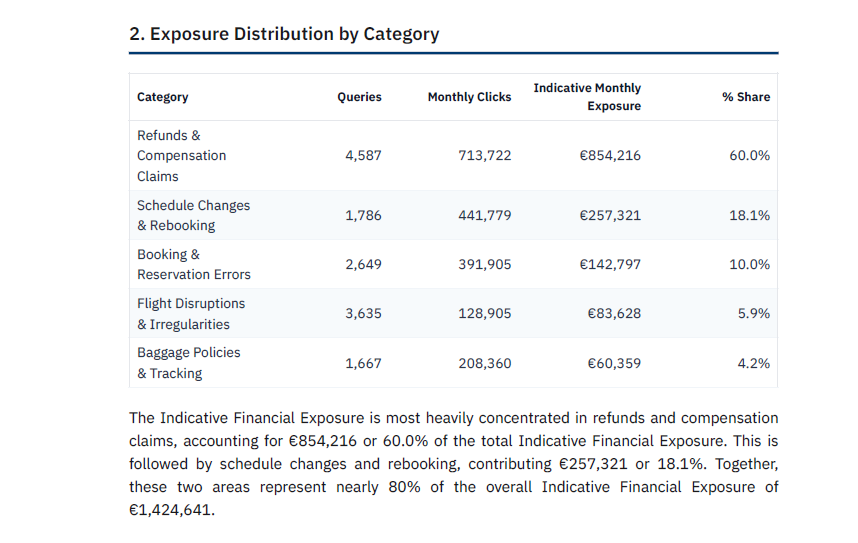
For each friction cluster, the report provides an indicative view on cost exposure based on observed demand signals and conservative modeling assumptions. These figures are directional and comparative. They are meant to support prioritization and risk assessment, not to function as savings targets or financial forecasts.
In addition, the report links friction areas to suggested ownership domains and outlines design-level intervention patterns. These elements are intended to support internal alignment and framing. They do not define solutions, timelines, or implementation scope.
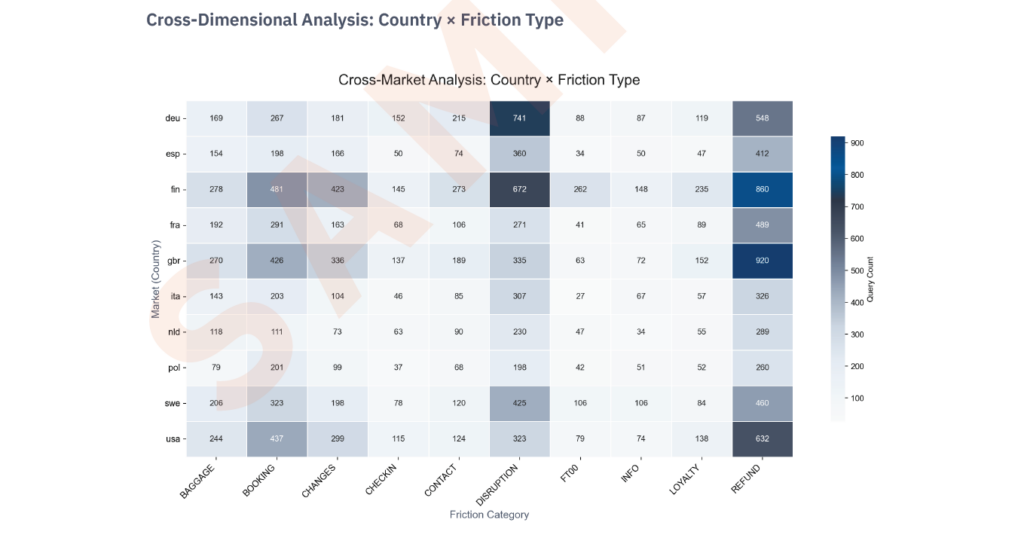
The report is delivered as a recurring analytical artifact. It captures changes in demand patterns over time while maintaining a consistent structure, enabling organizations to revisit prioritization decisions with a stable external reference point.
Methodology
VeltraCX is based on the analysis of aggregated external search signals (Google Search Console data) as a proxy for unmet customer needs. These signals reflect situations in which customers actively seek help outside owned digital channels and therefore indicate potential self-service and process gaps.
Search queries are classified using a predefined friction taxonomy that groups related issues into consistent operational categories. This allows recurring patterns to be distinguished from isolated or incidental questions and provides a stable structure for comparison over time.
Indicative cost exposure is derived from observed demand signals combined with conservative modeling assumptions. Financial figures are directional by design and focus on relative prioritization rather than absolute savings. Low-confidence classifications are excluded from monetary calculations to avoid overstating impact.
The methodology is designed for decision support. It does not aim to establish causality, measure performance, or validate implementation outcomes. All interpretations and resulting decisions remain with the organization.
Who VeltraCX Is For and Who It Is Not
VeltraCX is designed for large travel organizations where customer experience and operations are managed at scale. It is most relevant for airlines, airports, and similar mobility providers that operate complex service processes and handle significant customer support volumes. Typical readers are leaders in CX, digital, operations, or central steering functions who are responsible for prioritization across teams rather than for hands-on implementation.
The product assumes an organizational context in which decisions are made based on structured inputs, trade-offs, and shared understanding across functions. VeltraCX is therefore intended for organizations that already have established operational ownership and are looking for an external perspective to inform where to focus next.
VeltraCX is not designed for startups, small teams, or organizations primarily looking for tools to optimize conversion, marketing performance, or on-site behavior. It is also not suited for teams seeking detailed UX audits, real-time monitoring, or execution support. VeltraCX provides intelligence to support decisions, not capacity to implement them.
Next Steps
If this perspective is relevant for your organization, we can review a sample Friction Intelligence Report in the context of your operation, based on your existing setup and support structure.
You can reach us at mail@veltracx.com